
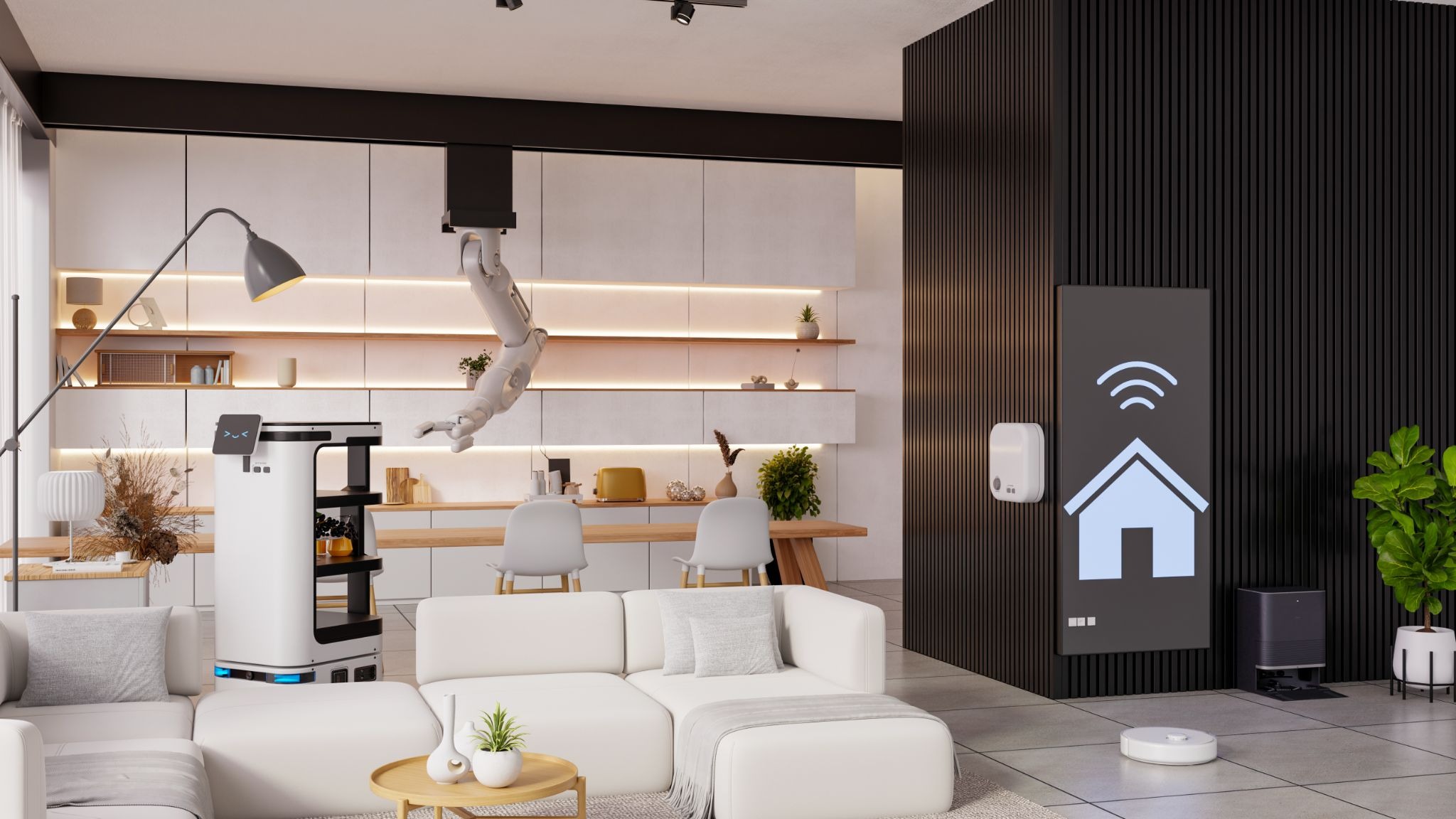
7 Ways AI Home Automation Transforms Lives?
Even within a few years, we have gone beyond simple smart bulbs and timers to homes which actually learn, predict and adapt. The following jump is driven by AI home automation (the integration of artificial intelligence and smart gadgets that control lighting, energy, security, and even daily routines).
Most Cases of the Buttons of AI in Home Automation Throughout this guide, we will take a tour of the best advantages of adding AI to your system of home automation using real-world applications and scenarios, and we will conclude with critical thinking and practical advice on how you can implement AI with consideration.
1. Indeed Customized Comfort: A House That Changes with You
The traditional smart home depends on manual schedules and scenes: Turn off the lights at 11 p.m. or Set the thermostat to 72 o C at 7am. That is useful, it is you doing the thinking still.
Your home begins to learn your tastes with AI home automation. Over time, AI can understand:
-
- When do you actually go to bed (not a set time).
- What are the rooms you use in the morning?
- How cold or hot you prefer it when you are working or relaxing.
The light settings that you prefer depending on the time of the day and weather. This is the essence of personalization of AI home automation where your environment can be thought of as context-aware rather than connected.
2. Minimal Energy and Reduced utility bills
Smart energy management is one of the most interesting advantages of home automation that involves the use of AI. The standard smart devices allow you to program or manage energy consumption remotely. AI takes it a step further to optimize it.
AI is able to examine the past patterns of use, the current occupancy, and even the local weather forecast so that it can make effective decisions, which include:
-
- Pre-cooling or pre-heating your home when the rates on electricity are less (when you have time-of-use billing).
- Switching off or lowering the brightness of lights and other gadgets in unused rooms.
- Turning on blinds to minimize heating in summer or conserve heat in winter.
To put it briefly, AI home automation will make a smart device an active energy manager that will constantly find a balance between comfort and saving.
3. Smart, Powerful Home Security
One of the first sources of smart home adoption was security but AI reinvents this. Rather than merely registering the movement or providing generic notifications, AI-based solutions are able to identify the arrangements, spot anomalies, and minimize the false-alarms.
AI-enhanced security can:
-
- Things like normal (your dog in the yard) and abnormal (someone loitering near the back door) things.
- Get to know the usual arrivals and departures of your house, and indicate those activities that do not correspond to the pattern.
- Turn on facial recognition (where it is legal and ethically set up) and it only gives you an alert when it sees a face it does not recognize.
This smarter filtering does not only enhance safety but also lessens alert fatigue, thus when your phone is buzzing then you are sure that it is something worth paying attention to.
4. Giving up some of the Tech Management, More Living
Ironically, smart homes of the early period usually complicated life: new applications to control, schedules to establish, software to update. Most individuals were left to do IT support in their own living room.
AI helps reduce that burden. With it, bypassing decision-making toward the system, reduces the amount of manual processes that you need to carry out in order to maintain your house running smoothly.
The way AI home automation makes life easier is as follows:
-
- Categorizes devices automatically (at bedtime, during a movie, at morning time, etc.).
- Recommends automations, such as “You frequently turn off these lights at 10.00 pm.–should we make this automatic?
- Gets updated when you change your schedule, instead of you having to re-program all the time.
In the long run, you are less likely to spend time setting up your smart home and spend much time enjoying the comfort it brings. That is what makes a house with gadgets look like a smart house and a smart house.
5. Improved Accessibility and Aging-in- Place
Automation through AI can change the lives of people with mobility issues, chronic illnesses, or older individuals who desire to remain at their homes longer.
Home automation with the help of the AI will allow caregivers and family members to make the environment safer and more accessible:
-
- Gesture- and voice based control reduces the physical contact with switches and buttons.
- Artificial intelligence can monitor abnormal behavior, including a loved one failing to get up at their normal time, and alert a loved one to the fact.
- Lighting paths will minimize the risk of falling at night (i.e., lights turning on progressively and slowly while entering a bedroom to a bathroom once a movement is detected).
6. Smooth Cross-Platform and Interoperability
With more and more smart devices in the home adding lights, locks, speakers, appliances, and sensors, the management of all these devices may become a nightmare. AI provides an opportunity to align these devices on brands and platforms.
The current AI enabled hubs and platforms are able to:
-
- Discover combinations of how various devices work with each other and make mixed scenes.
- Turn a high-level goal (lock in and lock out, change the temperature, turn the lights off, shut the blinds) into steps: lock doors, arm security, adjust thermostat, turn lights off, close the blinds.
- Smart standards Intelligence: Standards, such as Matter, are used together with AI logic to harmonize the differences in brands and make your devices operate as a single ecosystem.
7. Active Preventive Care and Proactive Data
AI is not only good at responding it is strong at anticipating. It can assist you in detection of problems before they turn out to be costly when incorporated into home automation.
Part of the real world examples are:
-
- Measuring the performance trends of HVAC to provide recommendations on changing the filters or having a service call to prevent failure.
- Observing a strange energy demand by one of the appliances, signs of probable failures.
- Keeping a watch on the battery levels in various smart gadgets and notifying you to replace or charge them before they die.
Your AI home automation system will notify you a week before your door lock battery fails as opposed to you standing in the rain because you forgot to check your door lock battery. These minor forecasting touches have a cumulative effect of creating a home that is not weak.
Critical Thinking: AI-based Home Automation Tradeoffs
The advantages are obvious, but there are no tradeoffs to the integration of AI in your home. You need to be cautious about the stuff you are empowering:
-
- Privacy: AI technologies usually depend on information regarding your habits, places, and activities. Do you feel at ease with the storage and utilization of that data? Do you trust the vendor?
- Excess automation: Excessive automation may be annoying and disorienting. When your home is erratic, then the members of your family can revolt against it instead of valuing it.
- Reliance on connectivity: A lot of AI can be based on cloud computing. The disruption can be restricted by internet failures or termination of services.
- Prejudice and fallacy: AI is not fallacious. I do not know who you are, or you have wrongly assumed what you like, or you have wrongly identified an anomaly; it can be frustrating.
Careful application of AI home automation implies selecting sellers attentively, knowledgeable use of data policies and coming up with automation that augments your life instead of dictating it.